Eclipse glasses ISO 12312-2: how to check a safe pair for 2027
Updated 16 October 2026 · 7 min read
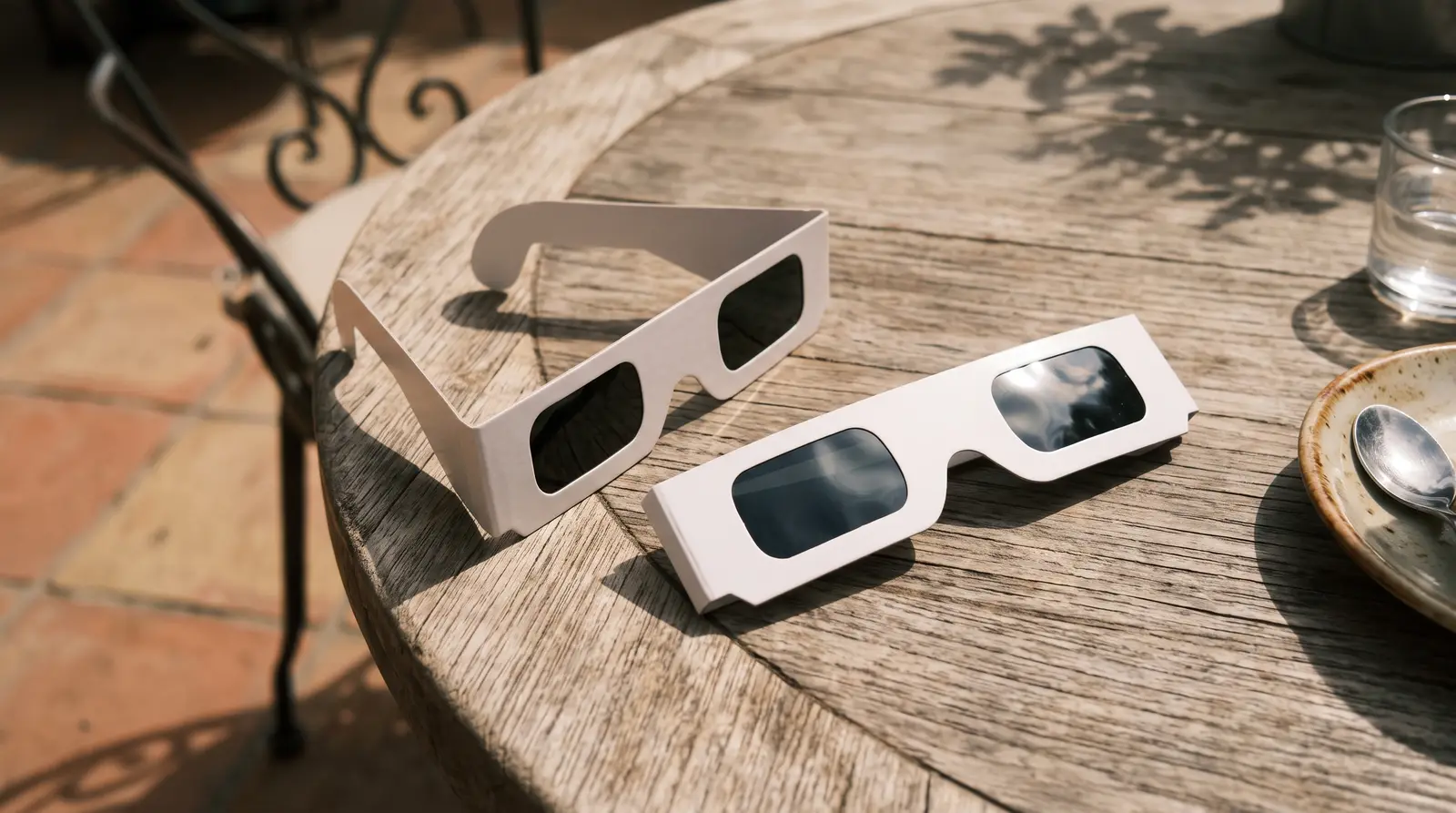
Safe eclipse glasses meet the international standard ISO 12312-2, which sets how much visible, ultraviolet and infrared light a filter for looking directly at the Sun may let through. A label alone does not prove compliance: buy from a manufacturer that has shown its products comply, or from that manufacturer’s authorised dealers, and inspect every pair before use. Eclipse glasses are for your eyes only; binoculars, telescopes and cameras need their own solar filter on the front.
You will need them for every partial phase of the 2 August 2027 eclipse. In southern Spain that means most of the morning, apart from a totality lasting a few minutes. Outside the path, in Madrid for example, you need them for the whole event. The safety guide explains when you may take them off.
What does ISO 12312-2 cover?
ISO 12312-2 is titled “Filters for direct observation of the Sun”. It was adopted in 2015, confirmed in 2020 and replaced older national standards. In Europe it is published as EN ISO 12312-2:2015. According to the American Astronomical Society (AAS), which tracks the standard closely, it covers:
- Light transmission. The filter must cut visible sunlight to a range equivalent to welding filters of shade 12 to 15. Ultraviolet transmission may be no higher than visible transmission, and infrared transmission is limited too. You cannot see UV or IR, so you cannot judge these limits by looking.
- Filter quality. The filter must be free of defects such as bubbles, scratches and pitting that could impair vision.
- Mounting. The filter must be held securely and cover both eyes, and the frame must fit an adult face without sharp edges.
- Labelling. The product must carry the manufacturer’s name and address, instructions for use, a warning about permanent eye injury, a reminder to discard damaged filters, and storage and cleaning advice.
The standard applies to non-magnifying glasses and handheld viewers. Ordinary sunglasses fall under ISO 12312-1, and filters for cameras, binoculars or telescopes are outside its scope.
ISO writes standards but does not certify products; independent accredited laboratories test conformity. The AAS points out that products should not be described as “ISO certified” or carry the ISO logo, so either is a warning sign.
How do you check a pair?
Who made it
The most reliable check happens before you buy. The AAS keeps a list of suppliers of safe solar viewers and filters: manufacturers that AAS task force members know from experience or that have shown the AAS their products conform to ISO 12312-2. The AAS no longer vets resellers and retailers, so buy directly from a listed manufacturer or from a dealer that manufacturer names as authorised.
For Europe, the AAS refers readers to a separate list run by Spanish volunteers, Eclipse Seguro. It checks documents and does not test glasses: a test report from an accredited EU laboratory, product markings showing the manufacturer, the CE mark and a model number that matches the certificate, and an authorised representative in the EU for makers based outside it. The site states that its review is unofficial and its list is not exhaustive. The AAS does not supervise it.
What the label should show
On a pair sold in the EU, look for:
- the reference EN ISO 12312-2 (or ISO 12312-2:2015);
- the CE mark;
- the manufacturer’s name and address;
- instructions and warnings, including to discard the glasses if damaged.
A pair missing any of these should be rejected, but a correct label proves nothing on its own: counterfeiters print the same text, and some put a reputable manufacturer’s name on their own products.
The physical inspection
Before each use, hold the glasses up and look at both filters. Discard them if a filter is scratched, punctured, torn or coming loose from the frame.
The visual test
The AAS describes a simple test. It cannot measure UV or infrared, so it does not prove a pair is safe, but it catches many fakes:
- Indoors, put the glasses on and look around. You should see nothing except very bright lights, and those should look faint. If you can make out furniture or pictures on the wall, the glasses are not dark enough.
- Outdoors on a sunny day, the only thing you should see is the faint reflection of the Sun off a shiny surface.
- Glance at the Sun for under a second. It should appear as a sharp-edged, round disc, comfortably bright, against a black background. Depending on the filter it may look white, bluish, yellow or orange.
In the AAS’s words, a pair that passes is probably safe, but only if it also came from a trustworthy source.
Where do fakes come from?
Fakes reach buyers through channels where nobody checks the maker. The AAS advises against buying from marketplace listings, online ads, search results and shops that are “cashing in” on the eclipse without knowing the products. Buy from a listed manufacturer or one of its named dealers.
Glasses from friends, or handed out by museums, planetariums and science centres, are usually fine if you can trace them back to a listed manufacturer.
Price tells you nothing either way: a cheap pair may be genuine and an expensive one fake. Judge by the source.
Can you store and reuse eclipse glasses?
According to the AAS, viewers can be reused if they come from a manufacturer whose product was tested by an accredited laboratory, are undamaged, and are less than ten years old. Older printed warnings to look for no more than three minutes at a time, or to throw the glasses away after three years, no longer apply to compliant viewers. Glasses bought for an earlier eclipse from a reputable source can serve again in 2027 if they are still in perfect condition.
To keep them usable:
- store them at room temperature in their sleeve, a case or a clean dry envelope;
- clean only with a microfibre cloth, soft cloth or tissue;
- keep cardboard frames dry, since wet cardboard swells and can come away from the filters;
- inspect them again before every use.
Glasses or filters for binoculars, telescopes and cameras?
- Never use eclipse glasses with binoculars, a telescope or a camera. NASA and the AAS warn that optics concentrate sunlight, which can burn through the glasses and injure your eye instantly. ESA adds that eclipse glasses held behind optics do not work.
- Instruments need a solar filter mounted on the front, in front of the lens or telescope tube, held firmly enough not to fall off. With such a filter on, you do not need eclipse glasses to look through the instrument.
- Filters that screw into a telescope eyepiece are dangerous. The AAS says to throw them away.
- Finderscopes on a telescope must be capped, removed or filtered as well.
Front filters come in metal-on-glass, aluminised polyester film and black polymer versions. The AAS considers all three effective; they differ in durability, cost and the colour of the image. Inside the path, choose a filter you can take off and put back on quickly, because the instrument is used unfiltered only during totality. Instruments with a built-in, non-removable solar filter work for the partial phases but cannot show totality.
The AAS supplier list also covers filters for optics and smartphones. For cameras, see how to photograph the solar eclipse.
How many pairs do you need?
- One pair per person, worn for the whole partial phase. When people share, someone waiting their turn is tempted to look without protection.
- A spare or two per group, because cardboard glasses get bent, sat on or blown away.
- Children need glasses that stay in place, and they must be supervised whenever they use them. The standard sizes frames for adult faces, so check the fit.
- If you wear prescription glasses, keep them on and wear the eclipse glasses over the top.
Buy early, so that in the last days you are not choosing between no glasses and glasses from an unknown seller.
Quick checklist
- Manufacturer on the AAS list, or an authorised dealer of one; in Europe, also check Eclipse Seguro.
- EN ISO 12312-2 and CE on the product, with the manufacturer’s name and address printed.
- No scratches, holes or loose filters.
- Indoors you see almost nothing; the Sun looks like a sharp, comfortable disc.
- Never combined with binoculars, telescopes or cameras.
Then plan where to be: totality lasts 2m55s in Cádiz, 4m28s in Algeciras and 1m53s in Málaga. See the map and where to watch in Spain.