Eclipse 2027 in Morocco, Tunisia and Egypt: longest totality
Updated 16 October 2026 · 7 min read
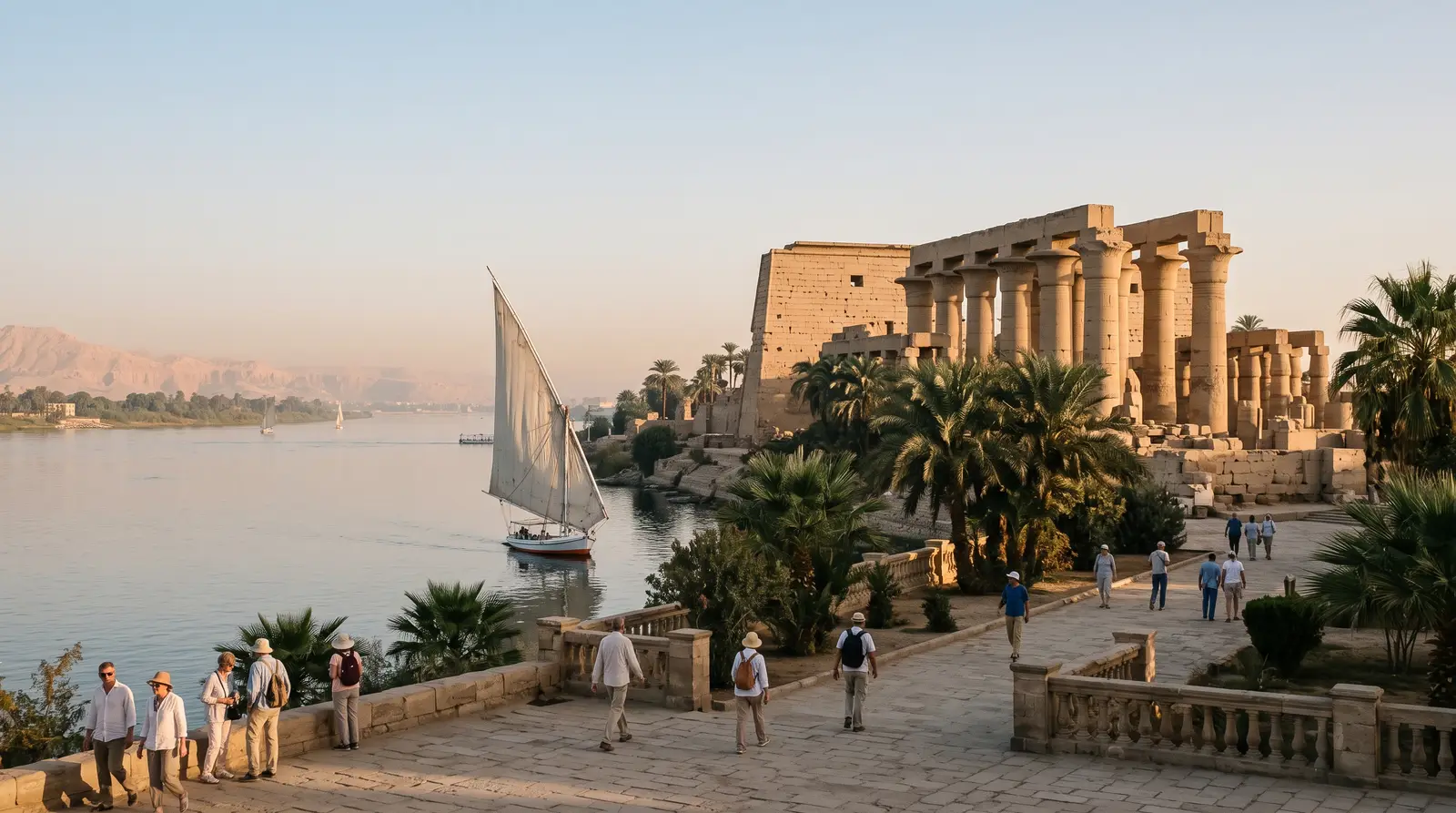
The longest totality of the 2 August 2027 eclipse is in Upper Egypt: 6m23s on the central line near Luxor, where the historical clear-sky odds are also the best on the whole path. East of Spain, totality grows steadily: about 4m51s in northern Morocco, 5m40s on the Tunisian coast around Sfax and more than six minutes in the Nile valley.
The tables below cover the main towns in each country, computed from NASA’s eclipse elements. We give no safety or entry advice; check your own government’s travel advice, linked below. The path itself is on the interactive map.
How does the eclipse change from west to east?
The Sun climbs as the shadow moves east. In Spain and Morocco totality comes in mid-morning with the Sun about 38 to 42° up. Over Tunisia it is around 55°, over Libya close to 70°, and in Upper Egypt above 80°, nearly overhead, at about one in the afternoon local time. Looking almost straight up is easier from a reclining chair or a mat.
The greatest duration on Earth, 6m23s, is at 27.14°N, 30.60°E, in the Nile valley. NASA’s predictions do not include the lunar limb profile, so durations and contact times can shift by 1 to 3 seconds.
Clear-sky odds in the tables are historical, not a forecast: the share of days from 26 July to 9 August in 2001 to 2025 with low cloud cover at the eclipse hour, from satellite data on a 1° grid. The clear-skies page compares every town in the path.
Morocco: the closest option from Europe
The central line runs close to Tangier and Tétouan, just across the Strait from Spain, which get about 4m51s, a few seconds more than Ceuta and a little more than anywhere in mainland Spain. Times below are UTC+0: Morocco moved to UTC+0 permanently from 20 September 2026, so on the clock the eclipse comes about two hours earlier than in Spain. Check this again before you travel in case the rule changes.
| Town | Totality | Totality begins (local, UTC+0) | Sun altitude | Clear-sky odds |
|---|---|---|---|---|
| Tangier | 4m51s | 08:44:40 | 38° | 61% |
| Tétouan | 4m51s | 08:45:07 | 38° | 61% |
| Fnidek | 4m50s | 08:45:13 | 38° | 61% |
| Al Hoceima | 4m26s | 08:46:57 | 40° | 43% |
| Larache | 4m18s | 08:44:20 | 38° | 46% |
| Nador | 4m14s | 08:48:18 | 41° | 48% |
| Ksar El Kebir | 3m42s | 08:44:52 | 38° | 61% |
| Berkane | 3m16s | 08:49:32 | 42° | 77% |
Northern Morocco’s odds are similar to Ceuta’s and lower than the best of the Costa del Sol. The Atlantic coast around Larache scores worse, at 46%, while Berkane further east (77%) has better odds but shorter totality. Rabat, Casablanca and Fes are outside the path: 98.5%, 97.1% and 98.4% of the Sun is covered there, which is not totality.
Algeria in brief
The path crosses northern Algeria, with long totality in the west and on the high plateaus: Oran has 5m08s (65% clear-sky odds) and Batna 5m16s (75%). Algiers sits just outside the edge at 99.9%, still only a partial eclipse. Algeria uses UTC+1.
Tunisia: long totality and good odds on the coast
The path covers central and southern Tunisia, and the central line passes close to Sfax, where totality lasts around 5m40s with the Sun at 56°. Historical odds rise to 85 to 92%. Local time is UTC+1.
| Town | Totality | Totality begins (local, UTC+1) | Sun altitude | Clear-sky odds |
|---|---|---|---|---|
| Sfax | 5m40s | 10:08:45 | 56° | 85% |
| Sakiet ed Daier | 5m36s | 10:08:50 | 56° | 85% |
| Kasserine | 5m27s | 10:05:24 | 54° | 62% |
| Gafsa | 5m08s | 10:05:38 | 54° | 92% |
| Houmt El Souk | 4m41s | 10:09:42 | 57° | 90% |
| Gabès | 4m05s | 10:08:38 | 56° | 90% |
| Zarzis | 2m52s | 10:11:12 | 57° | 69% |
| Kairouan | 2m44s | 10:08:47 | 55° | 87% |
Sfax, near the central line and on the coast, is the strongest single choice. Gafsa, inland, has the best odds in the table (92%) with 5m08s. Kairouan, close to the edge, gets only 2m44s and Msaken barely 41 seconds, so check the exact spot on the map before choosing.
Libya in brief
Eastern Libya gets about six minutes: Benghazi has 6m09s and Al Abyār 6m00s, at around 11:28 local time (UTC+2) with the Sun at 68°. The Benghazi cell has low historical odds, 24%, while Qaryat Sulūq has 5m54s and 87%. Tripoli lies just outside the edge, about 9 km away. Before considering Libya at all, read your government’s travel advice for it.
Egypt: the longest and clearest totality
In Upper Egypt the central line follows the Nile valley between Asyut and Luxor. Many towns get more than six minutes, the Sun is above 80°, and the historical clear-sky odds are 93 to 99%. Local time is UTC+3 (EEST).
| Town | Totality | Totality begins (local, UTC+3) | Sun altitude | Clear-sky odds |
|---|---|---|---|---|
| Jirja | 6m23s | 12:59:28 | 81° | 97% |
| Sohag | 6m22s | 12:58:43 | 81° | 97% |
| Luxor | 6m21s | 13:02:02 | 82° | 93% |
| Akhmīm | 6m21s | 12:58:49 | 81° | 97% |
| Ţahţā | 6m20s | 12:58:01 | 81° | 97% |
| Abū Tīj | 6m11s | 12:57:17 | 81° | 96% |
| Qina | 6m10s | 13:01:33 | 81° | 96% |
| Asyut | 6m07s | 12:56:50 | 81° | 96% |
| Esna | 5m45s | 13:02:48 | 82° | 93% |
| Mallawī | 5m24s | 12:55:40 | 80° | 99% |
| Minya | 4m12s | 12:55:34 | 80° | 99% |
| Kom Ombo | 3m39s | 13:06:00 | 83° | 93% |
Luxor is the natural base for many travellers, two seconds short of the maximum. Sohag, Jirja and Akhmīm, further north along the river, have a second or two more and 97%. Cairo, Giza and Alexandria are outside the path. Cairo gets 94.7% coverage and lies about 177 km from the edge, so a day trip from Cairo means a long journey south.
Totality falls around one in the afternoon in early August, so plan for shade before and after it, water and a hat.
Saudi Arabia in brief
The path crosses south-western Saudi Arabia. Jeddah has 5m59s at 13:22 local time (UTC+3), with the Sun at 76° and 66% historical odds. Abhā, further south, has 6m04s but only 5%. Mecca is also inside the path, but non-Muslims may not enter the city, so we do not suggest it for eclipse travel. The path then crosses Yemen and northern Somalia before leaving land.
Which country should I choose?
- Short trip from Spain or Europe: northern Morocco, about 4m51s in Tangier and Tétouan.
- Long totality with good odds, closer to Europe than Egypt: Sfax and the Tunisian coast, about 5m40s and 85%.
- Longest totality and best historical weather: the Nile valley between Sohag and Luxor, 6m20s or more and 93 to 97%.
The planning rules from Spain apply everywhere: arrive at least a day before, be in place well before first contact, and keep a backup site in another direction. Where you do not know the roads, an organised eclipse tour can handle transport on the day.
Check official travel advice first
Security, entry rules and local conditions vary by country and region, and they change; we do not assess them. Before booking, read your own government’s current advice for each country you plan to visit, and check it again shortly before you leave. Two starting points:
- United Kingdom: GOV.UK foreign travel advice, with a page for Morocco, Tunisia, Egypt, Libya and Saudi Arabia.
- Spain: Recomendaciones de viaje del Ministerio de Asuntos Exteriores, with a country-by-country list and the competent embassy for each.
Eye safety is the same everywhere
Look at the partial phases only through eclipse glasses certified to ISO 12312-2 or a proper solar filter; sunglasses are not safe. Remove the filter only once the Sun is completely covered, and put it back on at the first flash of light. Binoculars and cameras need a solar filter on the front. With the Sun almost overhead in Egypt, the long partial phase tempts people to glance up without protection, so keep the glasses on until totality has started. See our eye safety guide and, for the Spanish part of the path, where to watch in Spain.