How to watch the eclipse 2027 safely without hurting your eyes
Updated 16 October 2026 · 7 min read
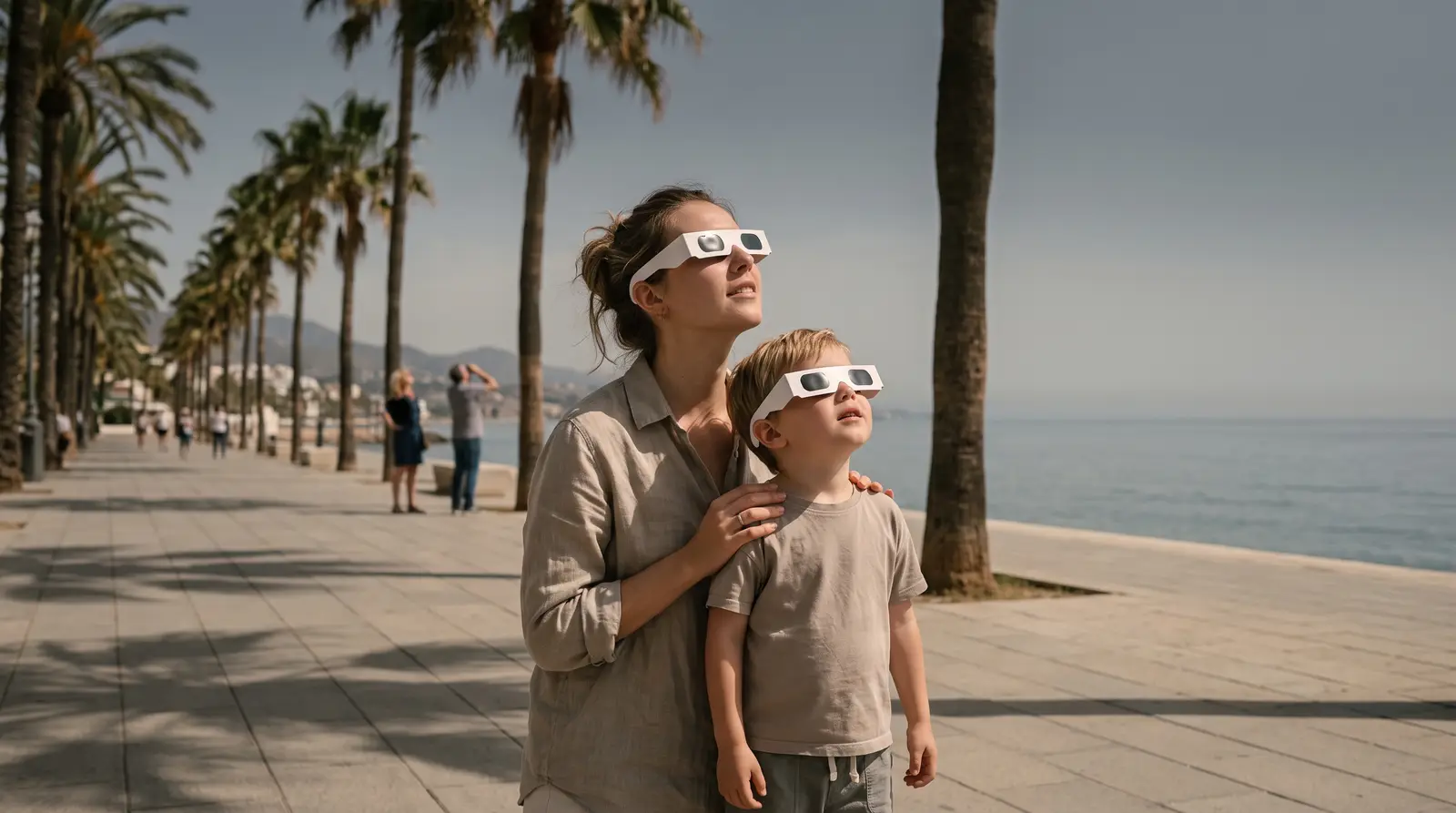
To watch the 2 August 2027 eclipse safely, look at the Sun only through eclipse glasses or a handheld viewer that meets ISO 12312-2, or watch it indirectly with a pinhole projector. Sunglasses never protect your eyes. You may look with bare eyes only during totality and only inside the path of totality; the moment the first bright point of the Sun returns, put the glasses back on.
In southern Spain totality falls between roughly 10:45 and 10:52 CEST.
Why is a partial eclipse dangerous?
Even when the Moon covers most of the disc, the uncovered sliver is still the Sun’s bright surface. Because the sky dims and the glare feels bearable, people stare far longer than they would at a normal Sun.
Looking at the Sun can burn the retina, an injury called solar retinopathy. The Spanish Society of Ophthalmology (SEO) warns that it can cause loss of central vision, distorted vision and permanent dark spots in the visual field, and that it can happen without any pain. The American Academy of Ophthalmology explains why: the retina has no pain-sensing nerves, so you do not feel the damage as it happens.
This applies in full outside the path. Seville sees 98.4% of the Sun covered and Madrid 86.3%, and in neither city is there a moment when it is safe to look without protection.
What protects your eyes?
Eclipse glasses and handheld viewers (ISO 12312-2)
ISO 12312-2 is the standard for filters you look through directly at the Sun, and both NASA and the American Astronomical Society (AAS) refer to it. Glasses and viewers that meet it dim sunlight to a comfortable level and also block invisible ultraviolet and infrared light.
How to use them:
- Inspect them before each use. If a filter is scratched, punctured, torn or coming away from the frame, throw the glasses away.
- Keep your prescription glasses on and put the eclipse glasses over them.
- Stand still, put the glasses on while looking down, then look up at the Sun. Look away again before you take them off.
- Through a compliant filter you can look at the partially eclipsed Sun for as long as you like.
How to buy a genuine pair (labels, fakes, sellers) is covered in our guide to eclipse glasses and ISO 12312-2.
Solar filters for binoculars, telescopes and cameras
Never look at the Sun through binoculars, a telescope or a camera viewfinder without a proper solar filter mounted on the front of the instrument. Never use eclipse glasses behind an optical instrument either: the instrument concentrates sunlight, which can burn through the glasses’ filter and injure your eye instantly.
According to the AAS:
- The filter must sit on the front of the instrument, firmly enough not to come off if the instrument is bumped.
- Filters that screw into a telescope eyepiece, sometimes sold with cheap telescopes, are dangerous and should be thrown away.
- Small finderscopes on a telescope must be capped, removed or filtered too.
Ask an experienced amateur astronomer before you use a filter with optics for the first time.
Pinhole projection
With this method you never look at the Sun. Stand with your back to it and let sunlight pass through a small hole onto a card, a wall or the ground, where the image shows the Sun’s crescent. A kitchen colander, a straw hat, a perforated spoon or your own crossed fingers all work, and the gaps between tree leaves throw dozens of small crescents onto the ground.
Never look at the Sun through the holes. Projection works for the partial phases only; during totality the image is too faint to see.
Welding filters
Welding glass is safe only if you know its shade number for certain. The AAS says shade 12 or darker blocks enough sunlight, and shades 13 and 14 give the most comfortable view, with a green tint. Ordinary hardware shops rarely sell shade 13 and 14 filters. Do not use auto-darkening or adjustable welding helmets, which may not get dark enough or may not darken quickly enough. If you are not sure of a glass’s shade, do not use it.
What does not protect your eyes?
None of these are safe:
- Sunglasses, however dark.
- Smoked glass.
- Photographic film, negatives or X-ray film. ESA notes they darken the view but do not reliably block harmful radiation.
- CDs, DVDs or aluminium foil.
- Eclipse glasses held behind binoculars, a telescope or a camera.
- Auto-darkening welding helmets or glass of unknown shade.
- Damaged eclipse glasses with scratches, pinholes or loose filters.
A phone is not a filter either. Looking at the image on its screen is fine, but people framing a shot often glance past the phone at the real Sun, and a zoomed camera pointed at the Sun needs its own solar filter in front of the lens. For the camera side, see how to photograph the solar eclipse.
When can you take the glasses off?
During totality the Moon blocks the whole bright disc of the Sun and the faint corona becomes visible. NASA, ESA and the AAS agree that this is the only time it is safe to look without eye protection, and only for people inside the path of totality.
Step by step:
- Keep your glasses on through the whole partial phase.
- When the last bright bead of sunlight disappears and it suddenly gets dark, take the glasses off. If you look through them and see nothing at all, totality has started.
- Watch totality with your bare eyes.
- The moment a bright point of sunlight reappears at the edge of the Moon, look away and put your glasses back on.
Totality is short, so learn your local times before the day. In southern Spain they are as follows (third contact is second contact plus the duration; contact times can shift by 1 to 3 seconds):
| Place | Totality starts (C2) | Totality ends (C3) | Duration |
|---|---|---|---|
| Cádiz | 10:45:21 | 10:48:16 | 2m55s |
| Algeciras | 10:45:23 | 10:49:51 | 4m28s |
| Ceuta | 10:45:17 | 10:50:05 | 4m48s |
| Marbella | 10:46:46 | 10:50:02 | 3m16s |
| Málaga | 10:48:05 | 10:49:58 | 1m53s |
| Roquetas de Mar | 10:50:26 | 10:52:02 | 1m36s |
All times are CEST (UTC+2). In Cádiz, for example, you take your glasses off at about 10:45:21 and put them back on at about 10:48:16. Put them back a few seconds early rather than late. Each city page lists the full timetable, including when the partial phase starts and ends.
Outside the path: glasses for the whole event
In Madrid the eclipse peaks at 10:51:11 CEST with 86.3% of the Sun covered. Valencia gets 90.2% and Seville 98.4%. None of these is totality, so at no point may you take the glasses off while looking at the Sun. The same applies everywhere outside the path; if you are unsure which side of the edge you are on, check the map.
How do you keep children safe?
NASA, the AAS and the SEO all say children using eclipse glasses or viewers must be supervised. Check that the glasses fit and stay in place, that children understand they must not peek around them, and that nobody looks through binoculars or a telescope unsupervised. For younger children, a pinhole projector or a colander’s shadow on the ground is often easier than glasses.
Tips for the day
- Bring one pair of eclipse glasses per person, plus a spare or two in case one gets damaged.
- In southern Spain the Sun stands roughly 37 to 41 degrees above the horizon at maximum, so you do not need a clear view of the horizon, but you will spend a long time in direct summer sun. NASA recommends sunscreen, a hat and protective clothing.
- Do not look at the eclipse while driving.
- During totality, point binoculars and cameras away from the Sun before the bright surface returns, or put their filters back on first.
What if your eyes hurt or your vision changes?
According to the American Academy of Ophthalmology, symptoms of solar retinopathy usually appear 4 to 6 hours after viewing, sometimes only after about 12 hours. They include:
- blurred vision or a blind spot in the centre of vision, in one or both eyes;
- straight lines looking bent;
- changes in colour perception;
- greater sensitivity to light, or a headache.
If you notice any of these after the eclipse, see an ophthalmologist; the SEO recommends going straight away. The AAO notes there is no specific treatment, but an eye specialist can examine the retina and judge the extent of any damage. Eyes that feel “a little odd” after you have taken your glasses on and off many times are not by themselves a sign of injury, but if you looked at the Sun without protection, get checked.
The rules in short
- Partial phases: ISO 12312-2 glasses, a front-mounted solar filter on optics, or pinhole projection. Nothing else.
- Totality, inside the path only: bare eyes, then glasses back on the moment sunlight returns.
- Outside the path, including Madrid and Seville: glasses for the whole eclipse.
- Vision problems afterwards: see an ophthalmologist.
To choose where to see totality, read where to watch the total eclipse in Spain and check the historical clear-sky odds. For what to look for in those minutes, see what you see during totality.