What you see during totality: the 2027 eclipse step by step
Updated 16 October 2026 · 6 min read
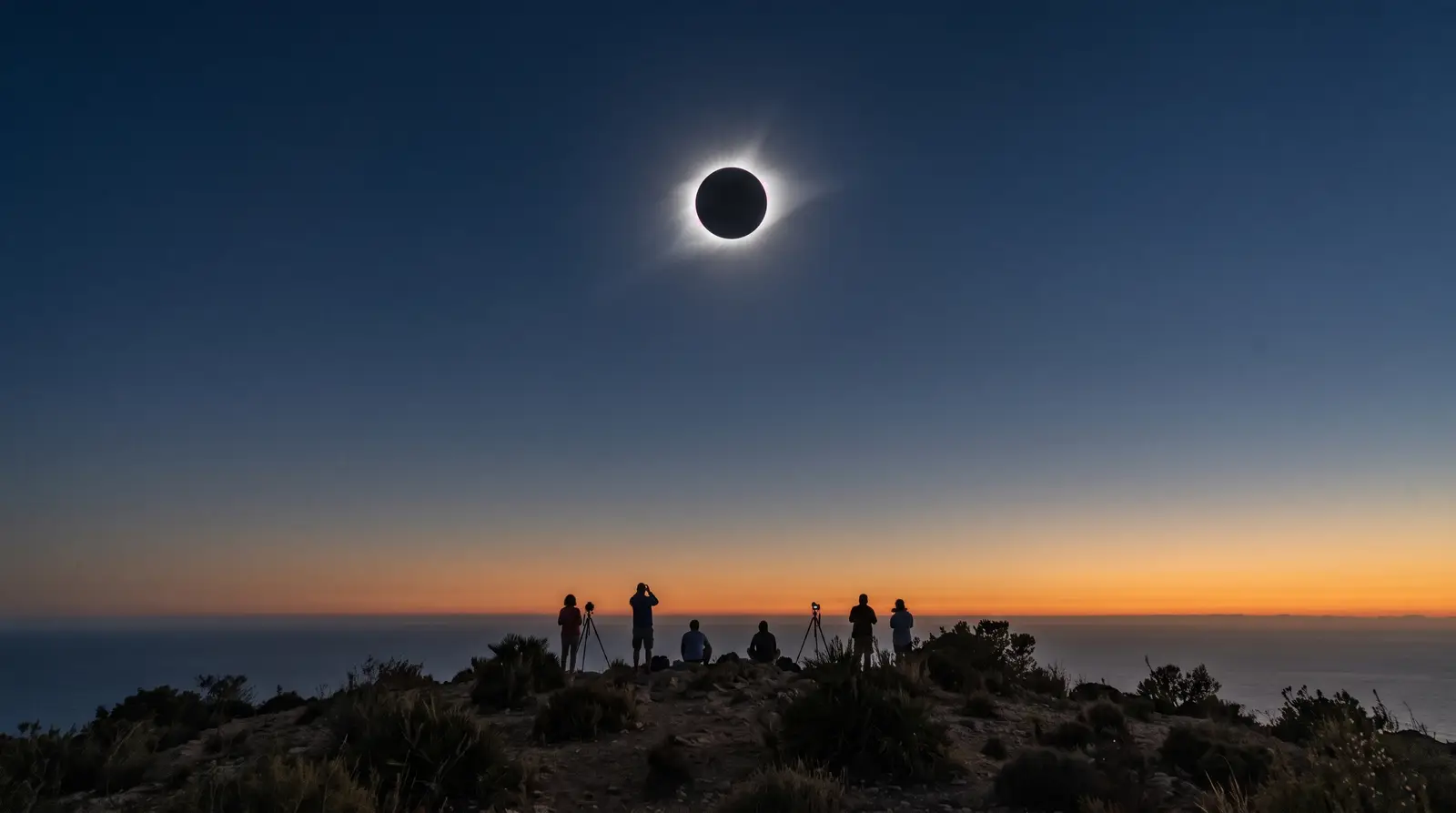
During totality you see the Sun’s corona with your bare eyes: pale white streamers around the black disc of the Moon, under a twilight sky with a sunset glow on every horizon. On 2 August 2027 in Cádiz the Moon first touches the Sun at 09:40 CEST, totality runs from 10:45:21 to 10:48:16, and the eclipse ends at 11:59. You need eclipse glasses before and after totality; only during totality itself is it safe to look without them.
The stages below use Cádiz as the example; other towns in the path see the same sequence at different times. Check yours on the map or its city page.
The timeline in Cádiz
| Stage | Local time (CEST) | What to do |
|---|---|---|
| First contact (C1) | 09:40:42 | Glasses on. The partial eclipse begins. |
| Partial phase | 09:40-10:45 | Glasses on. Light slowly changes. |
| Second contact (C2) | 10:45:21 | Diamond ring fades; glasses off once no sunlight is left. |
| Maximum | 10:46:48 | Middle of totality. |
| Third contact (C3) | 10:48:16 | Glasses back on as the first bright point appears. |
| Fourth contact (C4) | 11:59:32 | The Moon leaves the Sun. |
Totality in Cádiz lasts 2m55s, with the Sun 37° above the eastern horizon. Further south it lasts longer: 3m13s in San Fernando, 3m29s in Chiclana de la Frontera and 4m28s in Algeciras. Times can shift by 1 to 3 seconds because our calculation does not include the uneven edge of the Moon.
First contact and the partial phase
At first contact a small dark notch appears on the edge of the Sun. Without glasses you would notice nothing, which is why the partial phase is dangerous: the Sun stays bright enough to injure your eyes until the last sliver disappears.
Over the next hour the notch grows into a bite and then a crescent. NASA says the partial phase usually lasts 70 to 80 minutes; in Cádiz it is about 65. Put your ISO 12312-2 eclipse glasses on every time you look up. Sunglasses, however dark, are not a substitute.
While you wait, look for these:
- Crescents on the ground. A colander or a card with a small hole projects images of the crescent Sun, so you can watch without looking up.
- The light. Daylight weakens as the crescent thins, so slowly that you notice it only by comparison.
- The temperature. NASA notes that the air cools as the eclipse deepens; on an August morning in Andalucía it may come as a cool breeze.
The last few minutes before totality
The final five minutes before second contact go fast. The sky darkens to a deep blue, the colours of the landscape fade, and NASA describes how “an eerie silence” often settles over the crowd.
Shadow bands
In the last minute or two, faint wavy lines may ripple across the ground or a white wall. NASA describes them as fast-moving dark stripes with white gaps, caused by turbulence in the upper atmosphere (the same effect that makes stars twinkle). They are faint, not every eclipse produces them, and a white sheet on the ground makes them easier to see.
The approaching shadow
The Moon’s shadow crosses the landscape from west to east; in Cádiz it comes in from the Atlantic. With a clear view west from a beach, a rooftop or high ground, you may see that horizon darken first, like a storm arriving without clouds. This happens in the final seconds before totality.
Baily’s beads
Just before totality the last sliver of Sun breaks into a string of bright points: sunlight shining through valleys along the Moon’s rough edge. Baily’s beads last only a moment. They are still direct sunlight, so watch them through your glasses.
The diamond ring
When one bead is left, it blazes beside the first glow of the corona like a diamond on a ring. NASA uses this to mark the start of totality.
What can you see during totality?
NASA’s test for taking your glasses off: if you can no longer see any part of the Sun through them, it is safe to look without them. This applies only inside the path of totality and only while totality lasts. In Seville, Madrid or anywhere outside the path, the Sun is never fully covered and the glasses stay on the whole time.
With your bare eyes you will see:
- The corona, the Sun’s outer atmosphere, as pale streamers of white light spreading from the black disc of the Moon. NASA notes that the bright face of the Sun normally hides it, so a total eclipse is the only time most people see it. Look at how far the faint outer streamers reach; the shape differs at every eclipse.
- The chromosphere, a thin pink arc along the edge of the Moon for a few seconds at the start and end of totality. It is the layer of the Sun’s atmosphere just above its visible surface.
- Prominences, small pink-red features sticking out from the edge of the darkened Sun. They are clouds of plasma held above the surface by magnetic fields, and they are easiest to see near the beginning or end of totality, on the side the Moon has just covered or is about to uncover.
- A twilight sky. NASA compares the darkness to dawn or dusk, not night. A planetarium app will tell you which bright stars or planets may appear at your site.
- A 360° sunset. Outside the shadow the sky is still lit, so the horizon glows yellow and orange in every direction.
Totality in Cádiz lasts under three minutes, so decide in advance what to look at and in what order, for example the corona, then the horizon, then the prominences. If you want pictures, keep the camera work simple; the photography guide has a plan.
Third contact: glasses back on
Totality ends at third contact, 10:48:16 in Cádiz, and the sequence runs in reverse: the pink chromosphere on the western edge of the Sun, a single bright point (the second diamond ring), then the beads.
The moment you see the first bright point, put your glasses back on or look away. NASA and the American Astronomical Society agree that eye protection must go back on as soon as any bright sunlight reappears. Set an alarm on your phone for about 10 seconds before third contact at your exact location, using the time on your city page.
The shadow then races east towards the Mediterranean, and the shadow bands may show again.
The second partial phase
In the final hour the crescent grows back into a full disc until fourth contact, 11:59:32 in Cádiz. Keep your glasses on for every look. The roads will be busy straight after totality anyway, so you lose little by staying to watch the crescents return on the ground.
How totality differs along the Spanish coast
The sequence is the same everywhere in the path; the length and timing change:
- Near the central line (Algeciras 4m28s, Gibraltar 4m27s, Ceuta 4m48s) totality is longest and the beads and diamond ring are brief.
- Near the edge of the path (Málaga 1m53s, Vélez-Málaga 1m06s) totality is short, so the two diamond rings come close together.
- Just outside the path (Seville centre, 98.4% covered) there is no totality: no corona and no safe moment to remove glasses.
Weather matters more. Historical clear-sky odds for each town are on the clear skies page; they describe past Augusts and are not a forecast. For eye safety in detail, see how to watch the eclipse safely, and for choosing a place, see where to watch the eclipse in Spain.
Checklist for the day
- Write down the contact times from your city page.
- Have ISO 12312-2 glasses for everyone in your group, plus a spare pair.
- Pick a spot with a clear view east, where the Sun will be, and ideally west, where the shadow comes from.
- Set an alarm for just before third contact.
- Keep glasses on for everything except totality itself.