Spain's eclipses of 2026, 2027 and 2028: total and annular
Updated 16 October 2026 · 6 min read
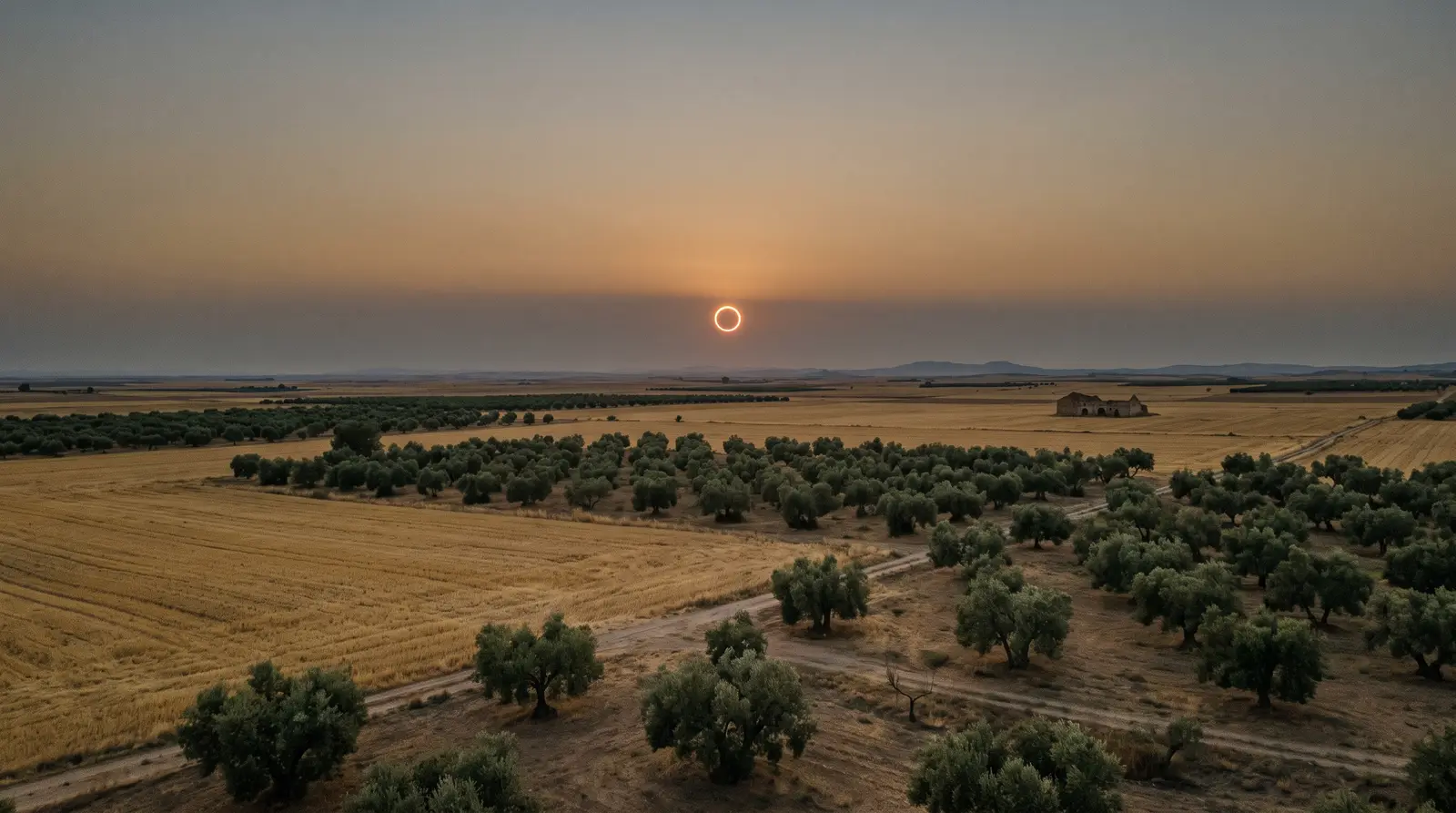
Spain sees three central solar eclipses in under two years. The total eclipse of 12 August 2026 crossed the north of the country at sunset, the total eclipse of 2 August 2027 crosses the far south in mid-morning, and the annular eclipse of 26 January 2028 crosses from Andalucía to the Valencia region late in the afternoon. Only the two total eclipses have a moment when you can look at the Sun without eye protection; the annular eclipse needs eclipse glasses from start to finish.
What is the difference between a total and an annular eclipse?
In both, the Moon passes directly in front of the Sun as seen from a narrow strip of Earth. The type depends on the Moon’s apparent size, which changes because its orbit is not a perfect circle.
- Total eclipse. The Moon looks at least as large as the Sun and covers it completely for observers in the centre of its shadow. NASA describes how the sky darkens as at dawn or dusk and the corona, the Sun’s outer atmosphere, becomes visible. Only during these minutes of totality is it safe to take off eclipse glasses.
- Annular eclipse. The Moon is farther from Earth, looks smaller than the Sun and cannot cover it, so NASA describes a ring around the Moon. At greatest eclipse on 26 January 2028 the Moon covers 92.1% of the Sun’s diameter (NASA magnitude 0.921). The ring is still direct sunlight: the sky does not go dark, the corona is not visible, and the American Astronomical Society (AAS) says filters must stay on for the whole eclipse, including the ring phase.
- Partial eclipse. Outside the narrow central path, only part of the Sun is covered. Glasses stay on throughout.
The three eclipses at a glance
| 12 August 2026 | 2 August 2027 | 26 January 2028 | |
|---|---|---|---|
| Type | Total | Total | Annular |
| Central path (NASA) | Arctic, Greenland, Iceland, Spain | Morocco, Spain, Algeria, Tunisia, Libya, Egypt, Saudi Arabia, Yemen, Somalia | Ecuador, Peru, Brazil, Suriname, Spain, Portugal |
| Where in Spain | Northern half, from Galicia to the Balearics | Southern tip: Cádiz province, Málaga coast, Ceuta, Melilla | Southeastern half: Andalucía to the Valencia region and Catalonia |
| Time of day in Spain | Evening, Sun low near sunset | Mid-morning, about 10:45-10:51 CEST | Late afternoon, Sun low before nightfall |
| Sun’s altitude | 12° in A Coruña, 2° in Palma | 37-41° | Low (IGN) |
| Longest central phase anywhere | 2m18s | 6m23s (near Luxor, Egypt) | 10m27s annular (in Brazil) |
| Central phase in Spain | 76 s in A Coruña, 104 s in Burgos | Up to 4m48s (Ceuta), 4m28s in Algeciras | About 7 min annular (Seville, Córdoba, Albacete, Valencia) |
| Glasses off? | During totality only | During totality only | Never |
Spanish times are CEST (UTC+2) for the summer eclipses and CET (UTC+1) for January 2028. Figures for 2026 and 2028 come from NASA and the Spanish National Astronomical Observatory (IGN); figures for 2027 come from our own calculation using NASA’s Besselian elements.
12 August 2026: total eclipse at sunset in the north
NASA’s eclipse table lists the central path of the first eclipse across the Arctic, Greenland, Iceland and Spain, with a maximum totality of 2m18s. According to IGN it was the first total solar eclipse visible from the Iberian Peninsula in more than a century.
In Spain the path of totality ran west to east across the northern half of the country, from A Coruña to Palma, through Oviedo, León, Bilbao, Zaragoza and Valencia. The south saw a partial eclipse. Because it happened in the evening, the Sun was low: IGN gives 12° at A Coruña, where totality lasted 76 seconds, 8° at Burgos with 104 seconds of totality, and 2° at Palma, shortly before sunset. A hill, a building or haze on the western horizon could hide the eclipse completely, so a clear view west mattered more than anything else. That low Sun is the main difference from 2027.
2 August 2027: total eclipse in the south
The second total eclipse comes in mid-morning, with the Sun high in the eastern sky. The path of totality crosses the southern tip of Spain (the Cádiz province, Gibraltar, the Málaga coast, Ceuta and Melilla) and continues across North Africa to Egypt and Arabia. Totality in Spain lasts longer than in 2026:
| Place | Totality | Start of totality (CEST) | Sun altitude |
|---|---|---|---|
| Ceuta | 4m48s | 10:45:17 | 38° |
| Melilla | 4m33s | 10:48:10 | 41° |
| Algeciras | 4m28s | 10:45:23 | 38° |
| Cádiz | 2m55s | 10:45:21 | 37° |
| Málaga | 1m53s | 10:48:05 | 39° |
The rest of the country sees a deep partial eclipse: 98.4% of the Sun covered in central Seville, just outside the path, 90.2% in Valencia, 86.3% in Madrid and 81.7% in Barcelona. None of these places gets totality, so glasses stay on there the whole time.
Worldwide, totality reaches 6m23s on the central line near Luxor in Egypt. Destinations across the Strait and further east are covered in the eclipse in Morocco, Tunisia and Egypt. For choosing a spot in Spain, see where to watch the total eclipse in Spain, and for clear-sky history the clear skies page (past Augusts, not a forecast).
26 January 2028: annular eclipse at the end of the day
NASA lists the central path of the annular eclipse across Ecuador, Peru, Brazil and Suriname, then over the Atlantic to Spain and Portugal. The longest annular phase, 10m27s, occurs in Brazil.
According to IGN, the annular path crosses the Iberian Peninsula from southwest to northeast and covers roughly half of Spain: almost all of Andalucía, southern Extremadura, Castilla-La Mancha, some areas of the Community of Madrid, Aragón, Murcia, the Valencia region, part of Catalonia and the westernmost Balearic Islands. The rest of Spain sees a partial eclipse.
IGN gives example times. The eclipse begins at 17:34 in Seville, 17:35 in Córdoba, 17:38 in Albacete and 17:39 in Valencia, and in all four the annular phase lasts about 7 minutes. It happens shortly before nightfall, with the Sun low in the southwest, which IGN warns will make it harder to observe. As in 2026, you need a clear, open horizon.
Unlike 2027, there is no safe naked-eye moment. Even at the height of the annular phase a bright ring of Sun remains, so eye protection stays on for the whole eclipse, and any camera or telescope keeps its front solar filter on throughout, as AAS advises. The sky dims but does not turn dark and the corona stays hidden; what you see is a centred ring of light, with the Sun low over the landscape.
Eye safety for all three
- Look at any partial or annular phase only through eclipse glasses or a handheld viewer that meets ISO 12312-2. Sunglasses are not safe, however dark.
- Cameras, binoculars and telescopes need a solar filter on the front. Never look through them with eclipse glasses instead.
- Take glasses off only during totality, inside the path, and put them back on as soon as the first bright point of Sun returns.
Details are in how to watch the eclipse safely and eclipse glasses and ISO 12312-2. If you plan to photograph 2027 or 2028, the photography guide explains filters and settings.
When is the next total eclipse in Spain after 2028?
IGN notes that the annular eclipse of January 2028 closes this run of three Iberian eclipses and that the next total solar eclipse visible from Spain will come in 2053. If you missed 2026 or were clouded out, 2 August 2027 is the last chance at totality from Spanish soil for decades. Find your local times on the map.